LOW CARBON INTENSITY SYNTHETIC GASOLINE

BRIDGE TO A NET-ZERO FUTURE

Connecting today’s mobility to tomorrow’s climate goals

IFS Blue Gasoline

synthetic low carbon intensity gasoline designed to meet conventional gasoline specifications.

Key characteristics include:

  • Production from natural gas via reforming, synthesis, and upgrading processes
  • Performance equivalence to refinery produced gasoline
  • Compatibility with existing gasoline engines, storage, and distribution systems
  • Cleaner burning than refinery produced gasoline
IFS Blue Gasoline™ is intended as a drop-in gasoline without requiring modifications to vehicles, terminals, pipelines, or retail fueling equipment.

Low Carbon Intensity (CI) score: facilitates meeting CFR and BC-LCFS regulations.
Production Pathway — High-Level Description

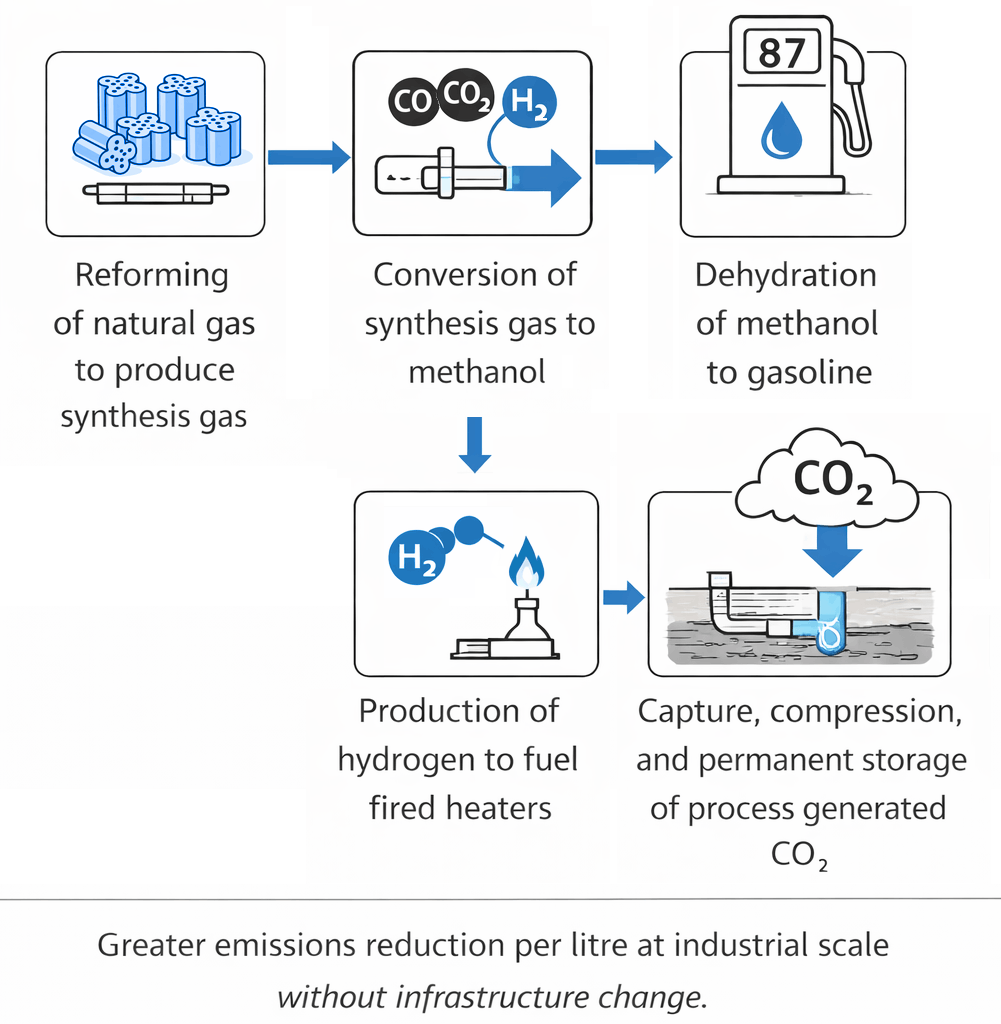
IFS Blue Gasoline™ is produced using commercially deployed industrial processes arranged in an integrated configuration.

At a high level, the pathway includes:

  • Reforming of natural gas to produce synthesis gas
  • Conversion of synthesis gas to methanol
  • Dehydration of methanol to gasoline
  • Capture, compression, and permanent storage of process generated CO₂
  • Production of hydrogen to fuel fired heaters
Each process step is based on established industrial technology. The integration of carbon capture and storage and hydrogen production is incorporated at the design stage to enable high capture rates.

Pathway Differentiation

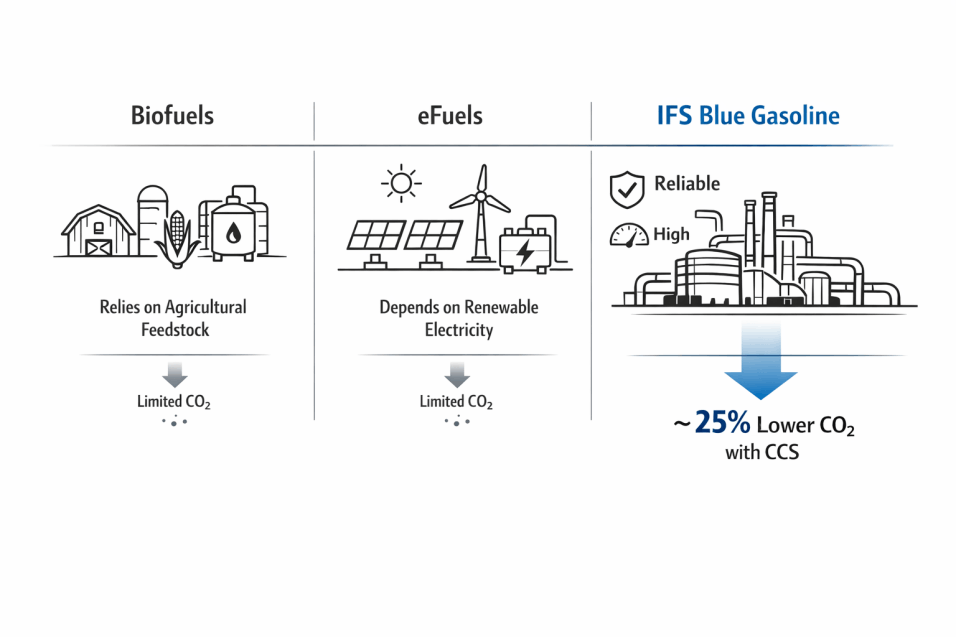
IFS Blue Gasoline™ represents a distinct low-carbon fuel pathway based on process-level emissions reduction.

Not a biofuel pathway
It does not rely on biogenic feedstocks, agricultural inputs, or biomass supply chains.

Not an electricity-dependent power-to-liquids pathway
It does not require large-scale deployment of renewable electricity or electrolytic hydrogen to achieve commercial production volumes.

Not a blending-based compliance approach
Emissions reductions are derived from integrated carbon capture and storage rather than incremental blending; as is the case with ethanol.

Performance-based design
Lifecycle emissions outcomes are determined through process efficiency and strongly regulated carbon capture verification.

Policy Relevance
Why This Pathway Matters

Gasoline remains a critical component of the transportation energy system due to the size, durability, and turnover rate of the existing vehicle fleet.

While electrification and alternative fuels are expected to expand over time, liquid fuels are anticipated to remain relevant for decades across multiple jurisdictions and use cases.

IFS Blue Gasoline™ is designed to:

  • Achieve greenhouse gas reductions at the fuel production stage
  • Operate independently of agricultural or land-use-constrained feedstocks
  • Enable emissions reductions without requiring changes in consumer behavior or infrastructure deployment
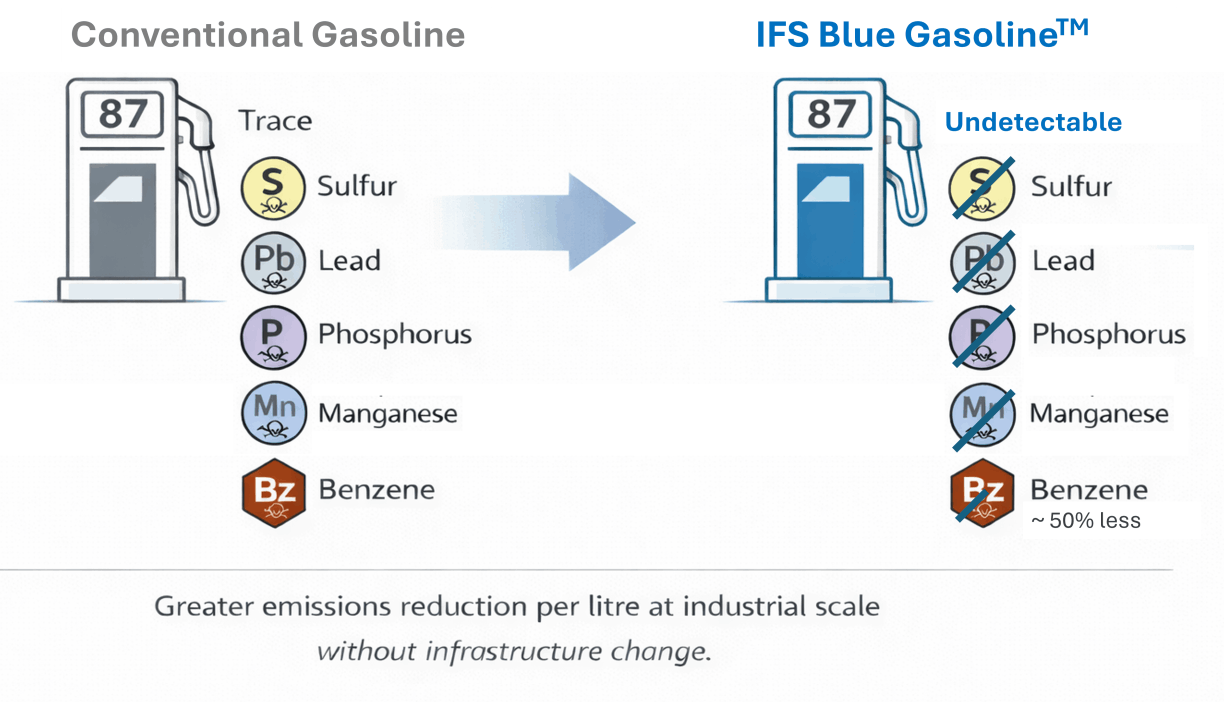
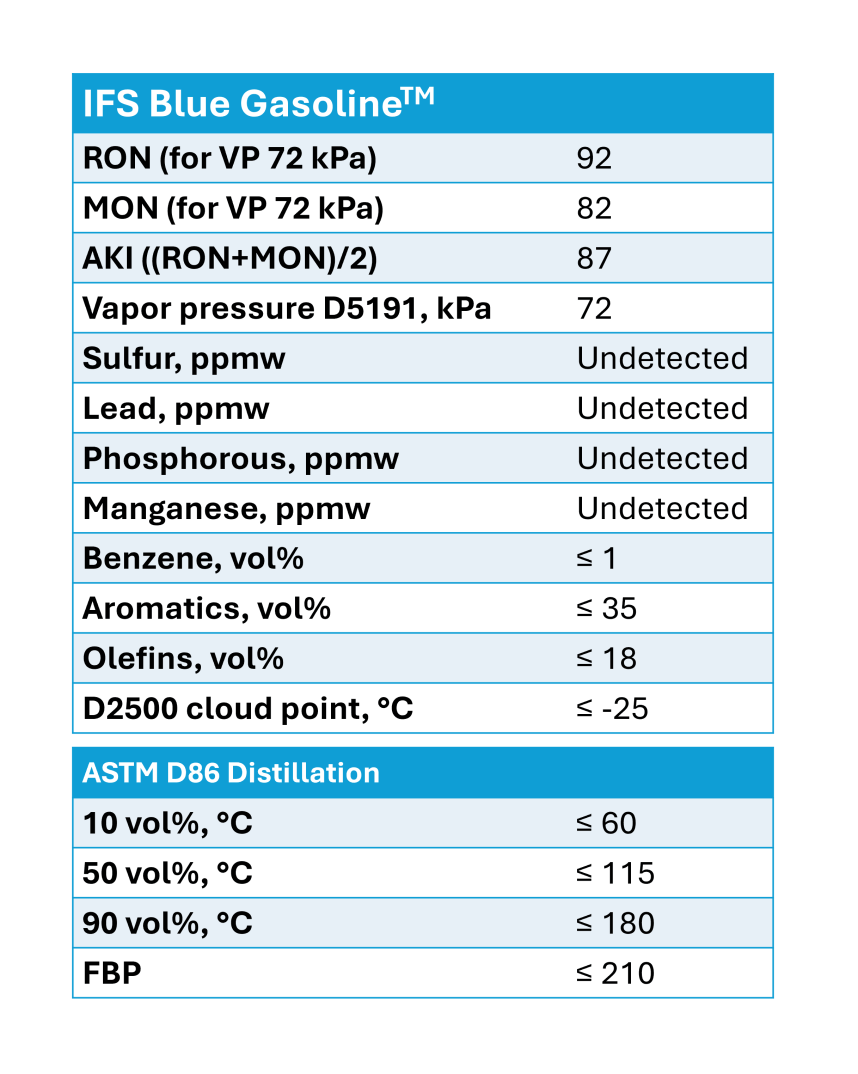
  • Minimize smog & particulate emissions. Zero Sulfur, Undetectable lead, phosphorus, manganese, and half the benzene than conventional gasoline
This pathway seeks to complement broader decarbonization strategies by addressing emissions associated with existing liquid fuel demand.

Carbon and Environmental Performance

IFS Blue Gasoline™ is designed to achieve a lower lifecycle greenhouse gas intensity than conventional refinery gasoline through capture and permanent storage of process generated CO₂.

Key considerations include:

  • Capture of a high proportion of CO₂ generated during methanol & hydrogen synthesis
  • Permanent geologic storage of captured CO₂ in government regulated facilities
  • Lifecycle performance assessed using jurisdiction-specific regulatory methodologies
  • Full lifecycle carbon intensity values are subject to: Pathway approval, Third-party verification, Applicable clean fuel regulatory frameworks
IFS will report emissions performance transparently and in accordance with regulatory requirements.

Community Health and Environmental Safety

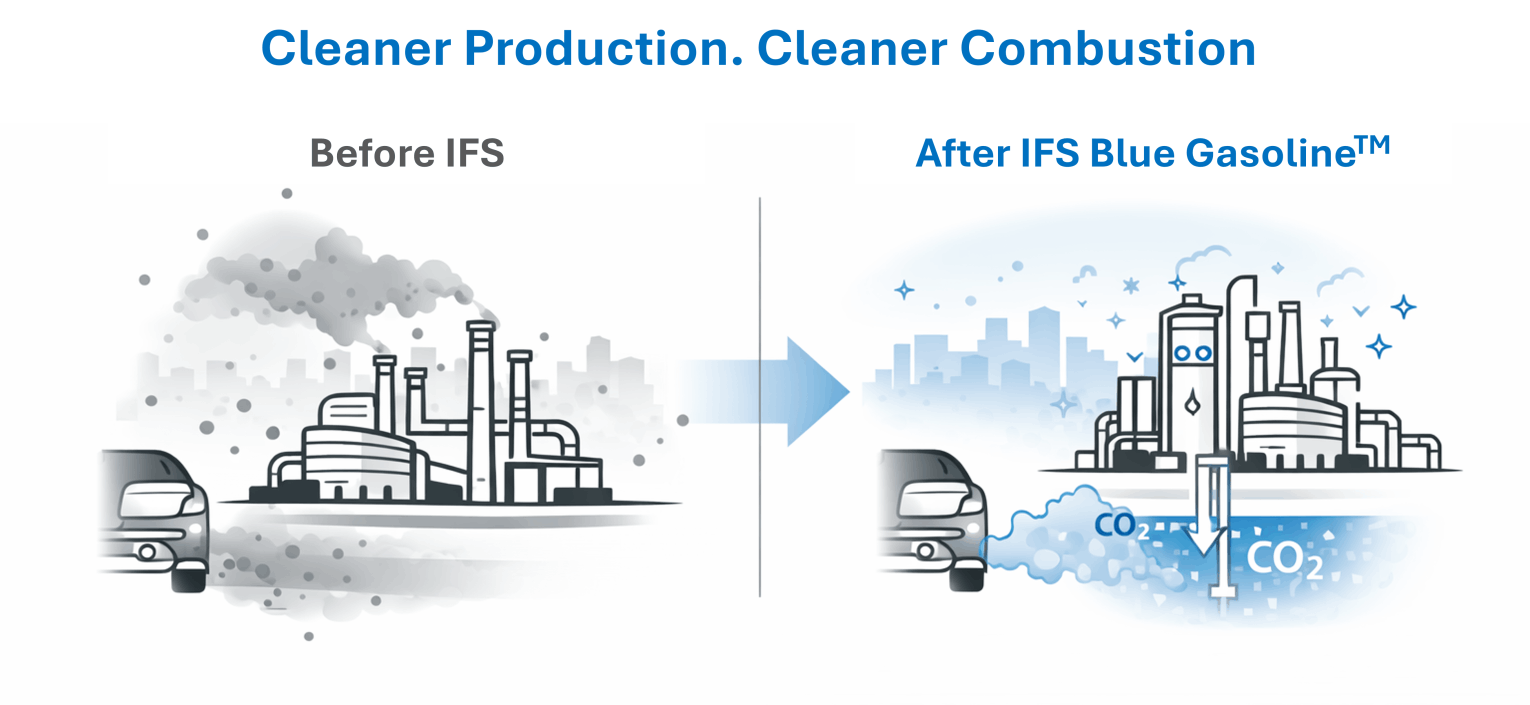
Cleaner Production - Cleaner Combustion

Beyond its significant greenhouse gas reductions, IFS synthetic gasoline offers substantial localized environmental improvements by eliminating harmful tailpipe pollutants and toxic additives inherent in conventional crude-derived fuels. Produced via the Methanol-to-Gasoline (MTG) process, this synthetic fuel contains undetectable levels of sulfur, lead, manganese, and phosphorus (ref. Bureau Veritas analysis). The elimination of sulfur is particularly critical, as it prevents the "poisoning" of catalytic converters, thereby ensuring these systems remain highly efficient at mitigating nitrogen oxides and carbon monoxide. Furthermore, the absence of metallic additives prevents the release of toxic particulate matter (PM2.5) into the roadside environment. The synthetic fuel also reduces benzene content - a known human carcinogen - by approximately 50% compared to traditional gasoline, directly curbing both evaporative and exhaust toxicity. These clean-burning characteristics allow the fuel to operate as a "drop-in" solution, providing immediate air quality improvements without requiring modifications to existing vehicles or distribution infrastructure. By reducing these pollutants, the project delivers measurable public health benefits, including lower morbidity and mortality rates associated with poor air quality. Ultimately, this cleaner molecular composition sets a new benchmark for transportation fuel, demonstrating that high-performance energy production can simultaneously enhance community health and environmental safety and be derived from a fossil feedstock.

When the Clean Fuel Regulations (CFR) and British Columbia Low Carbon Fuel Standard (BC LCFS) frameworks were originally developed, low-carbon gasoline produced from natural gas with integrated carbon capture and permanent storage did not exist in North America. IFS Blue Gasoline™ represents a new category of transportation fuel, achieving approximately 98% CO₂ capture during production while remaining fully compatible with existing vehicles and fuel infrastructure. Unlike bio-based ethanol blending strategies such as E10 or E15, IFS Blue Gasoline™ is a true drop-in fuel with no blending limits, no vehicle compatibility constraints, and no changes required to existing pipelines, terminals, storage facilities, or retail fueling infrastructure.

At IFS production scale of 36,000 barrels per day (approximately 2.1 billion litres per year), the lifecycle carbon reduction relative to conventional gasoline is equivalent to removing approximately 325,000 to 500,000 passenger vehicles from Canadian roads each year. This exceeds the emissions reduction impact typically achieved through E10 or E15 ethanol blending programs while maintaining the full performance, energy density, and logistical advantages of conventional gasoline. Using the same volume, the E10/E15 ethanol blending used at retail pumps today is equivalent to removing approximately 60,000 vehicles by comparison.

Through combining deep production decarbonization with cleaner combustion characteristics, IFS Blue Gasoline™ establishes a new benchmark for gasoline and demonstrates how meaningful emissions reductions can be achieved immediately using existing infrastructure while supporting the transition to a lower carbon transportation sector. 

Note: references and calculations available in the Full Memo Download

Market Applicability

IFS Blue Gasoline is intended for use by fuel marketers, distributors, and fleet operators seeking lower-carbon gasoline supply options that are compatible with existing vehicles and infrastructure.

Infrastructure Fit

Because the product is designed to meet conventional gasoline specifications, it can be transported and distributed through established pipelines, terminals, rail systems, and retail fueling networks, supporting deployment across Canada, the United States, and Mexico.

FUEL THE ENERGY TRANSITION

Interprovincial Fuel Solutions Ltd. is a Canadian Energy Transition company providing a pathway to reduce GHG emissions by producing low-carbon synthetic fuels.

FOLLOW US
HEAD OFFICE
  • 1500, 202 6th Avenue SW
  • Calgary, Alberta, Canada
  • T2P 2R9

  • Contact Us